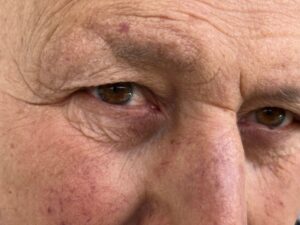
Crow’s Feet Treatment for Softer Lines Without a Frozen Look
 November 9, 2026 |
 Author
Crow’s feet are the fine lines that fan out from the outer corners of the eyes. They usually appear first when you smile, laugh, or squint, and over time some of them stay visible even when your face is at rest. The good news is that the same anatomy that creates these lines also gives a dermatologist several precise ways to soften them, and a skilled injector can do it without wiping the expression from your face.
Why Crow’s Feet Form in the First Place
The lines at the outer eye are tied to the orbicularis oculi, the ring of muscle that closes around the eye. Every smile, squint, and laugh contracts that muscle, and the skin over it folds in the same place again and again. Crow’s feet develop partly because the muscles around the eye keep pulling the skin into those folds.
Two things happen as a result. First, the folding becomes a habit, so the creases show up more easily and stay longer. Second, the skin itself changes, losing some of the support that once let it snap back flat. That is why a line that starts as a smile-only crease can eventually become a groove that is visible in a completely neutral face. Understanding which stage your lines are in is the single most useful step in choosing a treatment.
Dynamic Versus Static Lines: Matching the Treatment to the Line
Dermatologists generally sort crow’s feet into two groups, and the distinction explains why one person gets excellent results from injections while another needs a different approach.
| Line type | How it behaves | Treatments that target it |
|---|---|---|
| Dynamic | Appears when you smile, laugh, or squint and fades at rest | Botulinum toxin injections that temporarily relax the orbicularis oculi |
| Static | Visible even when the face is still, often a deeper crease | Hyaluronic acid dermal fillers, which are best suited to static, deeper creases |
| Surface texture | Fine crinkling, uneven texture, and dullness around the eye | Chemical peels, microdermabrasion, laser skin rejuvenation, topical retinoid and glycolic acid preparations |
Most people have a mix of all three, which is why a single product rarely delivers the whole result. A treatment plan is built around what your lines actually do.
Botulinum Toxin: Relaxing the Muscle That Folds the Skin
Botulinum toxin injections are often the most effective option for crow’s feet because they temporarily relax the orbicularis oculi, the muscle responsible for the folding. BOTOX Cosmetic is commonly used to soften the lines that appear when you smile, laugh, or squint. By quieting part of that muscle, the skin over it is no longer creased with every expression, and the lines soften.
The word temporary matters. Muscle relaxation wears off, so the creasing pattern returns unless treatment is repeated. Many patients treat it as maintenance rather than a one-time fix, and the schedule is set with the treating physician based on how your muscle responds.

Dermal Fillers for the Creases That Stay at Rest
When a line is etched in even with a still face, relaxing the muscle alone may not be enough. Hyaluronic acid dermal fillers are best for static, deeper creases, because they address the groove rather than the pull that created it. The eye area is delicate, so placement and product choice deserve extra care, and this is a region where an experienced injector matters more than usual.
Resurfacing Options That Improve the Skin Itself
Beyond muscle and volume, the quality of the skin around the eye shapes how visible crow’s feet appear. A range of options can be used for this, and they are often combined with injectables rather than used instead of them.
- Chemical peels to refresh surface texture
- Microdermabrasion for mild superficial improvement
- Laser skin rejuvenation to address skin quality around the eye
- Topical retinoid and glycolic acid preparations, which help improve skin texture over time
- The OBAGI Skin Care line, a topical skincare option used in some treatment plans
- Eyelid surgery, which addresses the eyelid area itself rather than the crow’s feet lines alone
Each of these works on a different layer or a different problem. Peels and microdermabrasion focus on the surface. Retinoids and glycolic acid support texture gradually at home. Lasers reach deeper into skin quality. A consultation is the point where those differences get sorted into a plan that suits your skin type and your tolerance for downtime.

How to Get Softer Lines Without a Frozen Look
The frozen look is not an unavoidable side effect of crow’s feet treatment. It is usually the result of treating too much, too widely, or treating the wrong thing. The outer eye is surrounded by muscle that also creates your smile, and a conservative approach leaves enough movement for expression to read naturally.
- Start conservatively and assess, rather than treating the maximum area at the first visit.
- Treat dynamic lines with muscle relaxation and reserve fillers for static creases that remain.
- Keep the treatment focused on the crow’s feet rather than spreading it across the mid-face.
- Review the result together and adjust at a follow-up rather than adding more immediately.
An honest assessment also helps. Some of what reads as crow’s feet is actually a combination of lines, skin texture, and volume change, and a plan that only addresses one of those will look incomplete no matter how carefully it is injected. A board-certified dermatologist can identify which component is dominant in your face before any product is chosen.
Short-Term Smoothing and Long-Term Skin Improvement
It helps to separate two timelines. Short-term smoothing is achieved through muscle relaxation and immediate hydration, which is why some change is visible early. Long-term skin improvement develops gradually as the skin responds over time to retinoids, acids, peels, or laser treatments.
Patients who expect both results from a single appointment often feel disappointed, while patients who understand the two timelines tend to be far happier with the outcome. Muscle relaxation handles the folding. Skincare and resurfacing handle the canvas.
What Home Remedies Can and Cannot Do
Home remedy articles circulate widely, and one common suggestion is to rub fresh lemon juice onto the crow’s feet, leave it for about ten minutes, and rinse with cold water, repeating a couple of times. Citrus juice on the thin skin around the eye can sting and irritate, so it is worth asking a dermatologist before trying it.
More importantly, no topical home remedy relaxes the orbicularis oculi muscle or fills a static crease. Moisturizing and sun protection are reasonable habits, but they act on the skin surface, not on the muscle contraction that folds it.

Choosing a Provider in South Denver
Colorado Dermatology Center is the practice of board-certified dermatologist Dr. James M. Swinehart, whose clinical experience spans more than three decades. The South Denver practice covers medical, surgical, and cosmetic dermatology, which means the person assessing your crow’s feet is also trained to recognize what else may be happening around the eye. The practice emphasizes personalized care, proven techniques, and natural-looking results, all of which line up with the goal of softer lines rather than a still, expressionless face.
Bring your questions to the consultation. Useful ones include: which of my lines are dynamic and which are static, what would a conservative first step look like, what are the risks for my skin type, how much downtime should I plan for, and how will we decide whether to add a second treatment.
Frequently Asked Questions
What is the most effective treatment for crow’s feet?
For lines that appear when you smile, laugh, or squint, botulinum toxin injections are often the most effective option because they temporarily relax the orbicularis oculi muscle that creates the fold. For creases that remain visible at rest, hyaluronic acid dermal fillers are generally better suited because they address the deeper groove rather than the muscle pull.
Can crow’s feet be treated without injections?
Yes, though the results work differently. Topical retinoid and glycolic acid preparations help improve skin texture over time, and chemical peels, microdermabrasion, and laser skin rejuvenation can address surface quality around the eye. These approaches support the skin itself but do not relax the muscle contraction, so lines that appear only with expression may remain.
Will treatment make my whole face look frozen?
It should not. A frozen look typically comes from treating too much or too widely. When treatment stays focused on the crow’s feet and starts conservatively, enough muscle movement usually remains for a natural smile. Reviewing the result at a follow-up and adjusting gradually is a more reliable route than treating aggressively at the first visit.
How soon will I notice a difference?
Short-term smoothing comes from muscle relaxation and immediate hydration, so some change appears early. Longer-term skin improvement develops gradually as the skin responds to retinoids, acids, resurfacing, or laser treatment. Because the two timelines differ, it helps to discuss expected sequencing with your dermatologist rather than judging the full result from the first week.
Do fillers work on crow’s feet?
Hyaluronic acid fillers are best suited to static, deeper creases, meaning lines that stay visible when your face is at rest. They address the groove itself. If your lines mostly appear when you smile, muscle relaxation is usually the more appropriate first step, and the two approaches are often combined after an assessment.
Crow’s feet respond best to a plan built around what your lines actually do: relax the muscle that folds the skin, support the skin’s texture over time, and add volume only where a crease genuinely stays at rest. Handled conservatively, that combination softens the outer eye while leaving your expressions intact.
 Posted in Procedures